Monday, June 27, 2011

Shakes on a Plane: Can Turbulence Kill You?


Image Credit: Jason Pratt

See that plane on the upper left?

Airplanes are scary. This indisputable fact originally came to my attention somewhere during college, when my relationship with flying matured from irritated ambivalence to full-blown phobic terror. There is something profoundly disturbing about being suspended thousands of feet in the air in a metal tube piloted by someone you’ve never even met. When I explain this to people who aren’t bothered by air travel, they foolishly try to persuade me with statistics about how flying is safer than driving blah, blah, blah…as though irrational fears could be soothed by something as banal as data.* Really, the only way to take my mind off my impending death is to pretend I’m not in an airplane at all. Distractions like food and music and in-flight magazine crossword puzzles go a long way toward accomplishing this, but all their hard work is undone the instant the plane encounters even a little turbulence. Turbulence has a way of snapping you back into the present moment, its every lurch and bump an unwelcome reminder that you’re hurtling through the stratosphere at over 500 miles per hour.

...this is what I think of every time I look at it.

My spring vacation† involved a total of 7 flights and amounted to something like 25 hours of time in the scary skies. Mercifully, every flight was smooth and trouble free, except for the very last one – a short jaunt from Dallas to Austin. I could tell the final phase of the trip was going to be less compliant than the previous portions. Thick clouds hung over the airport while we waited to board the plane. As soon as we were in the air, the pilots announced that there would be no beverage service due to some rough weather ahead. Throughout the next terrifying 40 minutes or so, we received various ominous announcements from the cockpit as the plane shuddered in increasingly malevolent winds, “We’re going to fly low today and try to stay below this storm,” and “Okay, so still pretty bumpy even at this altitude, but we should hopefully be there soon” etc. After we were safely back on the ground, I apologized to my boyfriend for all my in-flight whimpering, calling upon the mantra I’d heard dozens of times, “I know it’s just turbulence and it can’t hurt the plane, but it really feels like you’re about to crash.” But instead of laughing at me for being such a sissy, he launched into a lengthy discussion of how severe turbulence can cause plane crashes, and how the turbulence we’d just experienced had been pretty rough, and something about “wind shear” being capable of tearing planes in half.‡ I was really glad he didn’t share any of this with me during the flight.

Say It Isn’t So
Since anecdotal boyfriend babble is not always accepted as a reliable source, I’ve done some research on the question of whether turbulence can cause aviation disasters. The answer turns out to be a heavily-caveated yes. Turbulence can lead to plane crashes, but it is exceedingly rare. By some estimates, turbulence takes down about one plane per decade.§ This chaotic air movement - and its effects on the movement of the aircraft - is classified in degrees of light, moderate, severe and EXTREME (emphasis added by author). There’s also something called “chop” which is a more rhythmic bumpity-bumpity effect that comes in light and moderate flavors. Passenger perception of turbulence tends to be direr than that of experienced crew, so if you think you’ve been on the worst flight of your life, it’s likely you only witnessed moderate turbulence.

The good news is that airplanes are designed to withstand extreme turbulence (as well as lightning). The bad news is that, like all machines, airplanes age. Wear and tear that is no problem under normal circumstances can make aircraft less resilient to ridiculous levels of turbulence. Additionally, flying a plane that is being pummeled by rogue air masses isn’t the easiest thing in the world. Planes can be pretty much out of control during these episodes and, while temporary, the pressure is really on the pilot to react (but not overreact) in a way that keeps the aircraft from flying into the side of a mountain. If you think this all sounds melodramatic, consider a 1966 incident in which a BOAC (now British Airways) Boeing 707, flying near Mt Fuji, broke up in midair and crashed amidst harsh winds.

Your Wake, My Funeral
As frightening as that is, you should probably be more concerned about something called “wake turbulence”. Unlike turbulence created by naturally occurring differences in air flow (bad weather, pressure variations near mountains, jet streams, etc.), wake turbulence is caused by other airplanes, sort of like the wake created by a boat, except with air and much scarier. The worst part of wake turbulence is the creation of “wingtip vortices”, tornadoes of bumpy air generated by a plane’s wings that can take several minutes to dissipate.

Image Credit: NASA Langley Research Center
As with boat wake, this form of turbulence is not a problem for the planes creating it, but rather for the planes near it. Airports enforce strict limits regarding how much time must pass in between take-offs and landings to prevent one plane from getting caught in another’s wake. However, airports are increasingly crowded places with limited runway resources. Since they are travelling at slower speeds and pitched at awkward angles, planes that are taking off or landing are more vulnerable to turbulence. And, unfortunately, take off and landing are exactly the times when planes fly closest to one another.

As with other forms of turbulence, wake turbulence is more of a threat to small planes (especially when caused by the significant wakes of large commercial jets). Probably the largest aircraft to crash as a result of the phenomenon was a McDonnell Douglas DC-9 that got caught in the wake of a Lockheed L-1011 in 1972, prior to the implementation of the above-mentioned spacing regulations.** Wake turbulence allegedly also contributed to the 2001 demise of American Airlines Flight 587, though this crash is officially attributed to pilot error in response to the wake.

Reality Check
And now let me stress how very, very rare these occurrences are. Finding examples with which to freak you out was no easy task. Really, the biggest of your worries in the realm of bumpy air is encountering clear air turbulence (CAT) when you don’t have your seatbelt fastened. This is the surprise turbulence that occurs on a sunny day in seemingly smooth skies. The major impact of turbulence is not the causing of plane crashes, but rather bodily injury from all that jerking around. Every year, dozens of un-seatbelted passengers are seriously injured (and occasionally even killed) from being thrown around the cabins of twitchy planes. Your pilot isn’t just being an overbearing nag when he (or she) asks you to keep your seatbelt fastened when you aren’t walking around the cabin. CAT can come out of nowhere and knock the #%$ out of a plane. So buckle up, people.


* By the way, I’m afraid of cars too, making such logic even more useless to me.

† I went to Spain. It was lovely, thanks for asking.

‡ Wind shear turns out to be variations in speed and direction of air movement, which often leads to turbulence. Possibly he was talking about wake turbulence rather than wind shear. Maybe he even said wake turbulence. I don’t know, I was still a bit rattled (pun not intended, but permitted) at the time.

§ This was reported in the Guardian (via the aviation consultant Ascend) and they didn’t elaborate on what types of planes – or types of turbulence for that matter –were involved in these disasters.

** The DC-9 is still relatively small compared to a wide-body behemoth like the Lockheed L-1011.

Friday, June 10, 2011

Scientists make shocking discovery: dogs cannot read our minds

It's like The Village of the Damned. Image Credit: Tanakawho

“Canine telepathy?” asked one press release, referring to the similarly provocatively titled “Can your dog read your mind? Understanding the causes of canine perspective taking”, published online this week in the journal Learning and Behavior. The answer, of course, was no, although that was hardly the question being posed. The paper was not a cross-species ESP study, with dogs sitting in one room and being asked to guess what geometric shapes humans sitting in the adjacent room were being shown, but something a bit more practical. The authors examined how well different types of canids*(domestic dogs as well as wolves) were able to spot which of two humans was the attentive one – the one that would be more likely to reward them with treats.

While many animal lovers claim that dogs can tell when their owners are angry or sad – or merely plotting to take them to the vet – there is little more than anecdote to back this up. Yet it does often seem like dogs know what we’re up to. The dogs in my father’s household, who wouldn't exactly be described as well behaved, transform into circus-level performers when “chew-chews” (dog treat jargon) are about to be doled out. Treats are distributed after the correct execution of a command. Having spent far more time on “sit” than alternatives such as “roll over” or “play dead”, the dogs immediately place their butts on the ground as soon as a human picks up the biscuit jar. But do they believe that sitting somehow pleases us (not entirely false, though technically the desired behavior was obeying of commands) or have they just learned through trial and error that sitting = chew-chew? Forget whether dogs can read our thoughts, can they even comprehend that we have thoughts, that we pay attention (or don’t pay attention) and, if not, how do they manage to adjust their behavior to suit our wishes?

To answer some of these questions, scientist tested four types of canids – pet dogs (tested indoors), pet dogs (tested outdoors), animal shelter dogs, and tame wolves.† After preliminary “pre-training”, dogs were given the choice of begging for treats from either an attentive human – one that could see the dog – or a human whose attention was somehow diminished. The obscuring of attention was achieved by one of four means – the human 1) having their back turned to the dog, 2) reading a book, 3) holding a camera over their eyes or 4) wearing a bucket over their head. If that last one sounds a bit ridiculous, that was sort of the idea – to create a situation the animals were unlikely to have encountered previously.

Results showed that not only could domestic dogs read some signs of inattentiveness, so could wolves. All animals fared well in the task that involved choosing the attentive human over the one with their back turned. This provides possible evidence against the argument that dogs’ ability to read human mannerisms is a product of their domestication. In fact, in general, animal shelter dogs (whose home environments lacked the enrichments afforded to pet dogs) performed closer to wolves than to pet dogs. Response to the obstacles of camera and bucket were not extraordinary in most subjects, but in tasks where the inattentive human held a book, pet dogs (in both indoor and outdoor settings) did notably better at begging from the attentive human rather than the distracted reader. The book scenario was chosen specifically to simulate the kind of hurdle to getting attention that the average pet dog experiences in their daily routine. As expected, wolves and shelter dogs largely missed this subtle cue.

Additionally, when the challenging bucket task was repeated for long enough that animals might have a chance to learn from reinforcement (20 trials each), both dogs’ and wolves’ performance improved in tasks where they were rewarded for begging food from the attentive human. However, most failed to get the hint when treats were given out by the inattentive bucket-headed human.

Overall the researchers concluded that conditioning is important for canids to learn which human behaviors and mannerism will improve their chances of getting rewards, but that “a willingness to accept humans as social companions” was also key. Domestication, it seems, was not a requirement. What does all this say about whether dogs can conceive of thoughts in humans? Nothing. The authors readily admit that their tests were not designed to determine the mental process behind the animals’ decisions. That’s probably a wise move given that it’s pretty challenging (impossible?) to study cognition in non-verbal animals. Nevertheless they’ve managed to provide some insight as to how dogs “know” when we’re more likely to be receptive to their needs. Meanwhile, domesticated cats have long known that they can turn an inattentive reader into a receptive provider of affection and dinner simply by sitting on the distracting book. I draw no conclusions from that last (non-experimentally obtained) observation. Any inferences about the relative intelligence of cats and dogs are entirely of your own making.

* Canidae is a family of mammals that includes domestic dogs (Canis lupus familiaris) and wolves (various subspecies of Canis lupus) and well as foxes, coyotes and jackals.

† The whole indoor/outdoor business with the pet dogs was done to match the necessary testing conditions for the other animals. Wolves were tested outside, whereas shelter dogs were tested inside.

Wednesday, June 1, 2011

Indifferential Diagnosis #2: Hair Loss


Welcome to the long-overdue 2nd installment of Indifferential Diagnosis, the feature that poses – and even suggests possible answers for – the age-old question, “What’s wrong with you?” Last time we learned about visual hallucinations; today we delve into the equally disorienting world of hair loss. But before we begin, I would like to again draw your attention to the important disclaimer that I am not a doctor and indifferential is not a word.

As anyone who has ever swept the floors of an apartment inhabited by several females (or long-haired males) can tell you, human hair falls out all the time. The average adult head houses over 100,000 hairs and sheds between 50 and 100 of them each day. Hair loss – or alopecia, to use the clinical term – becomes noteworthy if it exceeds these parameters long enough to leave bald patches and/or completely eliminate hair. Hair can be lost from just the head or from the whole body. And, while it is typically associated with males of a certain age, the problem can occur at any age and in both genders.

Androgenetic and Involutional Alopecia
These are the staples of human balding and both increase with age. Prior to its ousting from the scalp, any given strand of hair has gone through a growth phase (2 to 3 years) and a rest phase (3 to 4 months). After a hair falls out, a new one takes its place and the cycle starts over – growth, rest, shedding of hair. Involutional alopecia is a gradual thinning of the hair caused by a shortened growth phase. Less growth means more hairs in rest phase, a higher rate of shedding and shorter hairs overall.

While living long enough almost guarantees some age-related thinning of hair, androgenetic alopecia – which you may know as “male pattern baldness” – only affects part of the population and is believed to be governed by hereditary factors. The “pattern” starts with a receding of the hairline at the temples, accompanied by the classic bald patch at the crown of the head (the spot where you would wear your yarmulke, if you’re into that sort of thing). Gradually these hairless patches may bleed into each other, resulting in the full Patrick Stewart effect.

Women too can be afflicted with androgenetic alopecia, but it tends to be less severe and starts later in life. Men with the genetic predisposition can experience noticeable hair loss as early as their teens. Hair loss from either androgenetic and involutional alopecia is largely permanent. As with aging overall, society has yet to produce a solid cure for this kind of gradual balding.

Tell-tale signs: The pattern of androgenetic alopecia is pretty easy to spot. Having relatives with similar hair loss histories is also a good indicator that you’re suffering from male pattern baldness.

Hormones
Amidst all the other risks associated with childbirth, hair loss gets little press. But major hormonal changes that occur during/after pregnancy can make your hair fall out. Menopause is another likely source for this. In both cases what happens is that a large number of hairs opt to exit the growth stage and make a beeline for the rest stage, yielding a bunch of shedding.* The good news is that such hair loss is only temporary. Once things calm down with the endocrine system, the normal growth cycle resumes, allowing hair to return at its previous rate.

Tell-tale signs: This condition has a more sudden onset than that of age-related thinning. The volume of extra hairs in your brush will inspire mild panic rather than just nagging doubt. There’s no reason to panic though. Don’t panic. Panicking never helped anyone grow hair.

Poison
Hair loss can be caused by exposure to an array of chemicals. These range from overdoses of medications – examples: Warfarin, a blood-thinner (though in higher doses it also functions as rat poison); Lithium, a mood-stabilizer (it’s not great for your kidneys either, FYI) – to work-related hazards (metals like mercury and arsenic have been causing problems for ages) to cold-blooded, premeditated attempts on your life made by your enemies. If you don’t take medications and your job exposes you to nothing stronger than white out and ball-point pens, you may want to ask yourself, “Who would benefit from my death and how much access do they have to my morning coffee?” Depending on what toxin is entering your system, the effects can be immediate (Warfarin) or build up slowly over time (arsenic), important factors to consider in deducing your would-be murderer.

Tell-tale signs: Poisons don’t just cause hair loss, they make people sick all around. Look for accompanying symptoms like nausea, weakness, dizziness, headaches, etc. Being poisoned will make you feel thoroughly awful.

Trichotillomania
Here’s an interesting source of bald patches – pulling out your own hair one strand at a time. Strange though it may sound, up to 4% of people are afflicted with an uncontrollable compulsion to pluck hairs from their head, eyebrows, etc. Think of it as an extreme form of hair twirling. The problem usually starts in adolescence or childhood, and many people outgrow it somewhere during adulthood.

Tell-tale signs: Hopefully you will realize if you’ve been doing this yourself, so this is more for spotting the condition in others (namely, your offspring). Watch out for bald-patches and vigorous denial of these being self-inflicted. Other anxiety-soothing fidgets (like nail biting) may also be an indicator. Trichotillomania isn’t especially common in calm and well-adjusted types.

Alopecia Areta
If you haven’t heard that term before, brace yourself for some disheartening news; there is a malady out there that can cause sudden and sometimes profound hair loss in perfectly healthy individuals and for no apparent reason. Alopecia areta (AA) is thought to be an autoimmune disease in which the body’s immune system targets its own hair follicles as perceived pathogens. Often the hair grows back, but it can fall out again and there is no way to predict when and if these recurrences will happen. At its most severe, the disease causes the loss of all hair from all parts of the body – a conditional called Alopecia universalis.

Tell-tale signs: The fun generally begins with a small bald patch somewhere on the scalp, unaccompanied by skin abnormality or discoloration. The complete absence of any likely cause is also a good indicator that AA may be to blame. Other than being freaked out by losing their hair, patients feel perfectly fine. The condition isn’t especially common though (less than 2% of the population suffers from it), so before you race to the doctor, you may want to review that paragraph on male pattern baldness (pretty ubiquitous once you get past your 20s). 

Ringworm
I used to think that ringworm was an actual parasite, but it’s just a fungal infection. Less gross, but still no fun. If it occurs on your scalp it will cause the hair in the infected area to fall out. The problem is easily treatable with antifungal creams, and your hair will grow back after the skin heals. Oh, and don’t forget that this is contagious. Housemates and pets (cats are notorious for spreading this stuff around) may also benefit from medication.

Tell-tale signs: The skin exposed by the lost hair will look infected (since it is). Unhappy words like “itchy”, “scaly” and “oozing” often crop up in descriptions of ringworm. †

Diabetes, Thyroid disorders, Lupus
Hair loss can be a symptom of an underlying disease. These are serious conditions that I can't help you with. Go see a doctor already.


* This change in the growth cycle is known as telogen effluvium (telogen is the rest phase) and can also be brought on by disruptions like stress, malnutrition or a high fever.

† The fungus that causes ringworm – Microsporum gypseum – also causes athlete’s foot. It’s an icky world we live in.

Sunday, May 8, 2011

A Minty-fresh Stalemate on Menthol Cigarettes


The story I’m about to tell you is figuratively yesterday’s news. Literally it comes from March of 2011, from 2009 and from 2 very different Perspective pieces published online in the New England Journal of Medicine (NEJM) a few days ago. These editorials address the debate surrounding a report presented to the FDA by the Tobacco Products Scientific Advisory Committee (TPSAC), which was created two years ago and tasked with determining whether menthol cigarette pose a greater risk to public health than your standard non-minty smokes. This is a large and complex issue, which will be addressed here with a certain brevity (and perhaps even bullet points) as I am leaving for vacation in less than 24 hours.

A Committee is Born
The TPSAC was created as part of the 2009 Family Smoking Prevention and Tobacco Control Act. This legislation also banned flavored tobacco products, with the notable exception of menthol cigarettes. Instead of being part of the original ban, menthols were given temporary exemption until their hazards could be assessed by the newly-formed committee.

The Controversial Report
After a lengthy examination of peer-reviewed literature on menthol cigarettes (as well as tobacco industry submissions), the TPSAC delivered an equally lengthy report.* It stated that, because there was not consistent evidence of greater toxicity in cigarettes treated with menthol, the risk to any individual smoker was no different whether they chose a minty or unflavored product. However, considerable evidence showed that menthol smokers had a harder time quitting than non-menthol smokers. Even more problematic, menthol cigarettes were determined to make it easier for people to start smoking in the first place. By softening the taste and feel of tobacco, menthol cigarettes facilitate smoking for novices who might otherwise be deterred by these harsh sensory realities. They are the wine coolers and peppermint Schnapps-spiked hot chocolates of the cigarette world.

The Report Card
The most frequently quoted sentence from the TPSAC report is its overall recommendation, “Removal of menthol cigarettes from the marketplace would benefit public health in the United States.” Critics – such as Dr. Michael Siegel, who wrote one of the aforementioned NEJM editorials – criticized the language for being weak and for deliberately avoiding making any recommendation for a ban. The second NEJM article, written by two doctors who served on the TPSAC, defended the report stating that critics failed to understand the purpose of a scientific advisory committee. They likened the maligned quote to the 1964 Surgeon General’s report on smoking, which stated, “Cigarette Smoking is a health hazard of sufficient importance in the United States to warrant appropriate remedial action.”. Okay, also a bit ambiguous, but one gets a better sense of what is being suggested. The “if, then” structure of the TPSAC recommendation fails to convey any urgency.

Mint-flavored Market
Perhaps the most interesting part of the menthol controversy is the history of the cigarette itself and how it became – in the U.S. –  a product marketed specifically to black consumers. Menthols were unleashed onto the public in the 1920’s, so the story goes, by Lloyd “Spud” Hughes, who accidentally discovered the idea after storing his own tobacco overnight in tin that also contained menthol. Spud cigarettes, with their purported breath-freshening properties, were originally marketed to the fashionable smoking elite. As the century progressed, they began to be viewed more as cough drops. One switched to soothing menthol cigarettes when stricken with a cold and then returned to their usual pack once they were on the mend.

But in the mid 20th century, the cigarettes began being targeted at the growing African American market. Cigarette manufactures not only created ads designed to appeal specifically to these consumers, they also ingratiated themselves by donating money to black community organizations and civil rights groups. By the 2000’s, menthols were the cigarette of choice among 70% of African American smokers (versus only 30% of white smokers). Given that African Americans have higher mortality rates from lung cancer than American whites, the role of menthol becomes not just a health issue, but potentially one of racial equality. In fact, Siegel suggests, the TPSAC was assigned the duty of investigating menthol cigarettes only because the exemption of menthol from the original legislation met with such strong opposition from the Black Congressional Caucus. But that’s a larger issue than can’t be tackled today, so on to…

The Bullet Points
  • Personally, I’m more for warnings than bans. Yet it does seem a bit odd that the Family Smoking Prevention and Tobacco Control Act would go through the trouble of banning something as obscure as cherry and strawberry flavored tobacco products and then exclude the one flavor that actually sells in meaningful numbers.

  • One of the weaker arguments against banning menthol cigarettes is that such a ban could create a black market for this sought after product. Seriously? (rhetorical question alert) Does anyone actually believe that menthol smokers would find drug dealers to sell them contraband cigarettes rather than just buying a non-mentholated brand they can get at their grocery store? And if black market business is such a concern, why are various recreational drugs illegal?

  • Is the FDA doing anything about Camel Crush cigarettes? Do those things still exist? They were being rather aggressively marketed when I first moved to Austin, with company representatives handing them out in downtown bars. It’s a regular cigarette that can be transformed into a menthol by simply squeezing the filter. This breaks a small menthol capsule that leaks minty fluid into the cigarette. The crushing of the capsule sounds similar to glass breaking. It just seems like a bad idea.

And now, I’m off to Europe where I’m told everyone smokes unfiltered, unflavored cigarettes and drinks hot coffee even in the middle of Summer.


* It’s over 200 pages and I don’t have time to read it right now. If you want to give it a shot, be my guest. It can be downloaded as a PDF from the FDA’s website.

Monday, April 18, 2011

Warning Colors

Image Credit: Benjamin Golub


Late last month the FDA shot down a petition to ban the use of artificial coloring in foods, despite acknowledging evidence that these additives may aggravate hyperactivity in children with behavioral disorders. In fact, the agency decided that even mandating warning labels about the correlation was unnecessary. Parents throughout the U.S. have been ranting about this ever since. How mad should you be over the FDA’s ruling? If Yellow No. 5 and its ilk are so safe, why don’t Europeans have to eat them? And who needs colorful food anyway?

Seeing Red
Controversy over food coloring is nothing new, and what makes or breaks a proposed ban is a mixture of science, public perception and industry lobbying. Early laws prohibiting the use of artificial yellow in margarine had more to do with bullying from the dairy industry (who stood to lose money to a cheaper new product) than with public health. Similarly, the 1976 FDA de-listing of Red No. 2 occurred despite inconclusive scientific data. Studies aimed at demonstrating the hazards of the additive were flawed and inconsistent, but a public relations storm was brewing and, in this instance, the FDA found it more favorable to appease consumers than the industry. By the time the decision was made, public opinion of Red No. 2 was so low that the makers of M&M’s candies discontinued red M&Ms, even though they got their color from chemicals still considered safe at that time.*

Scary cherry.
Image Credit: Jay Keaton
Following a new set of disputed data, in 1990 the FDA promised to phase out another crimson hue, Red No. 3 (used to make the cherries in canned fruit cocktail a shade other than boiled and processed brown), but without actually specifying when. † This time industry pressure was stronger than public outrage. Whining from the fruit cocktail lobby, who wisely assessed that their canned product would become completely undesirable without the pretty cherries, has managed to delay a full ban indefinitely.

Field research for this article – which involved a survey of my own refrigerator, a trip to the grocery store and a whim-driven purchase of a bag of Sour Patch Kids – revealed that maraschino cherries ‡ are as red as ever, but currently get their color from Red No. 40, which is also responsible for the pigmentation of my newly acquired gummy candy, and a long-forgotten jar of HEB brand plum-flavored fruit spread. However, Red No. 3 lives on in the standard set of assorted food coloring I purchased two years ago to make fake blood for a photo shoot (and eventually holiday cookies).

Weighing the Evidence
While not the only data supporting a connection between artificial food coloring and hyperactivity in children, the 2007 “Southampton study” was particularly important as it led to the phasing out of 6 artificial colors in the European Union (EU). It is worth noting that, of the 6 hues involved in the study, only 3 are on the list of colors currently approved by the FDA (Yellow No. 6, Yellow No. 5, and Red No. 40) and that the colors were examined in 4-color mixes (with a preservative added) rather than individually. § Still, the study found adverse effects among 8 to 9-year-old children with both mixes, including the second concoction, which was specifically designed to emulate the dose and variety of additives that would be encountered by the average lolly-eating British kid. As with the Red No. 3, the scandal factor surrounding this issue in Europe was high. In 2008 the Food Standards Agency recommended phasing out all 6 of the dyes used in the Southampton study in the EU. For this reason, people eating processed food (made by the same manufacturers, mind you) on the European side of the Atlantic have their snacks tinted with food-derived colors while those of us on the American side are still consuming the artificially-colored versions.

Color Cues
Unwilling to cope with beige snacks, Europe dealt with the bad news about artificial coloring by decorating foods with things like beet extract and paprika. There is much evidence that both our enjoyment of food and our comprehension of its flavor rely heavily on color. Studies have shown that subjects can better identify flavors in appropriately colored foodstuffs (lime drink colored green) than in those with mismatched colors (lime drink colored red). And let’s not forget the colossal flop of the deliberately de-colored Crystal Pepsi back in the early 1990s. Despite initially attracting consumers with its novelty value, the beverage did not look like a cola and therefore it failed to taste like one.

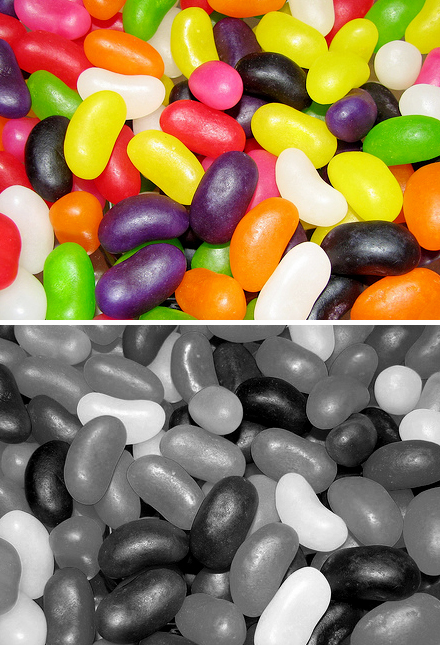
Without color vision, delicious jellybeans
would just look like insect larva.
Image Credit: Ross Websdale
In his clinical essay, The Case of the Colorblind Painter, Oliver Sacks tells the story of an artist who becomes completely colorblind following a head injury. Forced to view the world in only shades of grey, one of the many losses was that of a tasty meal. Sacks writes, “He found foods disgusting due to their greyish, dead appearance and had to close his eyes to eat.” Gradually, the patient gravitated toward foods that were in reality black and white (olives and rice, for example) as only these appeared “normal”.

From an evolutionary perspective, there is some value to judging a book by its color. Food hues not only warn against items that are likely to be spoiled or poisonous (blue and black) but also draw us toward essential nutrients (red peppers, orange carrots, green broccoli). One of the problems with colored snack food, whether its appearance is achieved through beet extract or through Red No. 40, is that it satisfies the urge to eat colorful foods without providing any of the nutrition benefits of real fruits and vegetables.

"The dose makes the poison"
So said sixteenth-century scientist Paracelsus, whose name was coincidentally brought to my attention this past week. In large enough quantities, drinking water can kill you. While I’m all for better food labeling, I’m not convinced of a need to ban artificial coloring altogether. As a child, I enthusiastically ate Kraft Macaroni and Cheese for lunch daily over the duration of an entire summer, but I wouldn’t call this a healthy meal, even without its synthetically derived yellow. Processed foods with or without artificial colors are often still high in preservatives, saturated fats and sugar – the latter ingredient was discussed at length in a recent New York Times article – and low in vitamins and fiber. The real issue is not the high volume of artificial food coloring consumed by U.S. children (and adults), but rather the high volume of artificial food. Occasional junk food treats are acceptable in low doses, but for everyday eating, the goal should be not to choose foods colored with naturally-derived dyes, but foods that don’t need additional color in the first place.


* Like a disgraced television executive, the red candies returned (a decade later) after the bad press died down.

† The studies in question involved feeding doses of Red No. 3 to mice that were much higher than what a human could ingest through food alone. People disagree on whether an additive should be proven safe in any dose or just safe in normal doses.

‡ I mention maraschino cherries because, shockingly, I did not encounter canned fruit cocktail during my investigations, and Dole’s website would not show me ingredient listings for their canned fruit. For now we’ll have to assume the same cherries are featured in fruit cocktail.

§ It’s entirely possible that a single ingredient is making other more well-behaved colors look bad. The sinister Yellow No. 6, for instance, or even the villainously un-colored preservative sodium benzoate, which appeared in both mixtures tested. This is the kind of experimental design that allows government agencies to stall and request “more research” before taking action.

Who told you this?

Harris, G. “Artificial Dye Safe to Eat, Panel Says.” The New York Times, 31 March 2011.

Burrows, A., 2009. “Palette of Our Palates: A Brief History of Food Coloring and Its Regulation.” Comprehensive Reviews in Food Science and Food Safety 8: 394-408.

Zampini, M., et al. 2008. “Multisensory flavor perception: Assessing the influence of fruit acids and color cues on the perception of fruit-flavored beverages.” Food Quality and Preference 19: 335–343.

“UK Food Standards Agency Cites Southampton Study In New Recommendation On Food Additives.” MedicalNewsToday.com, 13 Apr 2008.

McCann, D., et al. 2007. “Food additives and hyperactive behaviour in 3-year-old and
8/9-year-old children in the community: a randomised, double-blinded, placebo-controlled trial.” The Lancet 370: 1560-1567.

Tuesday, March 29, 2011

Diets, Drugs, and How to Live Forever Without Resorting to Vampirism


For a long time the only reliable way to extend lifespan was to eat less. Much less. In experiment after experiment, caloric restriction (CR) increased longevity in everything from yeast to primates. I would call this a fine tradeoff were it not for my deeply held conviction that a life without candy corn is not worth living. Not that I’m advocating industrialized civilization’s current level of run-amok gluttony, but really, a person needs a few empty calories to cope with the tedium of an average workday. Fascinating though the idea sounded, for me, and for most others of my species, caloric restriction was off the table. Then somewhere around 2006 I began reading about a molecule called resveratrol that was found in red wine and had demonstrated health benefits in laboratory animals similar to those provided by CR. But five years have passed and I’m still impatiently awaiting my life-extending miracle drug. What’s taking so long?

Less is More
The study of caloric restriction dates back to the Great Depression, when animal experiments were designed to examine whether prolonged food scarcity might damage longevity in mammals (humans, of course, being the real interest). But lab rats subjected to Depression-esque chronic hunger surprised scientists by living longer than control groups. Further experiments would show the same trend in other animals. Not only did CR extend lifespan, but it also extended health by delaying many diseases associated with aging.

Initially, such benefits were believed to result from a reduction in metabolic strain that causes cellular damage over time (free radical and all that business). But more recent experiments suggest that CR affects regulating pathways that govern gene expression. When the body’s sensors perceive food as being plentiful, resources are allotted to growth and reproduction.* When food is scarce, such expansions are put on hold in favor of damage control. The organism now focuses on cell protection and preservation (life-extended processes) while awaiting the next period of abundance. It’s no great stretch to wonder if one couldn’t somehow trick the body into believing feast was famine, and thus reap the rewards of CR without all the dreary dieting. Enter resveratrol.

Wining and Dining
In 2003 David Sinclair and Konrad Howitz published a paper in Nature asserting that lifespan (in yeast) could be extended by 70% through the activation of a class of proteins called sirtuins by the molecule resveratrol. Resveratrol, a naturally occurring polyphenol, is found in red grape skins and therefore eventually makes its way into red wine. It was an excellent candidate for life/health extension, since Americans had been scratching their heads for decades over how the French could eat meat and dairy-rich foods and still be reasonably slim and healthy (um, smaller portions perhaps?) The answer was clearly red wine. Never mind that the dosage of resveratrol fed to various model organisms was far higher than a human could obtain from wine, even if they had the most formidable of drinking problems.

Sinclair started the biotech company Sirtris to further research sirtuins and resveratrol, and went on to show that resveratrol improved health and reduced mortality in mice fed a high fat, high calorie diet. Videos of the fat-but-fit resveratrol-enhanced rodents outpacing ordinary obese mice on treadmills assured lazy humans everywhere that society was on the verge of having its cake and eating it too. Despite two separate papers that found flaws in the original research demonstrating resveratrol’s sirtuin-activating abilities†, in 2008 Sinclair and his partners sold Sirtris to the pharmaceutical behemoth GlaxoSmithKline (GSK) for a whopping US$720 Million.

And the Rest is History
Commercially, resveratrol is a pretty worthless molecule. As a natural substance it can’t even be patented. Additionally, it was often uncooperative in the lab, with difficulty maintaining consistent levels in blood sited as one significant issue. As a result, Sirtris’ research has focused more on creating and testing new drugs that mimic resveratrol’s (somewhat disputed) activation of sirtuins.‡ Additionally, the goal shifted away from increasing lifespan overall and instead toward treating the diseases of aging, such as type 2 diabetes and certain cancers. Partly this is because Sirtris is an FDA approval company, and the FDA does not consider aging to be a disease per se. But it’s worth noting that, while resveratrol did well for mice subjected to the unhealthy diet, it demonstrated no increase in longevity for normal mice, casting doubt on whether it actually functions by the same mechanism as CR.§

SRT501 was among the first of Sirtris’ drugs to be unleashed in human clinical trials, and in early 2008 it was holding its own in a phase 1 trial for use as a diabetes medication. It continued to climb the ranks of trial phases and to branch out into other disease trials. But in Spring of 2010 a trial testing SRT501 on multiple myeloma patients was called off early after several people developed kidney failure.** Sirtris halted the last of its remaining resveratrol mimic trials later that year. Results from the debacle won’t be released until next year, and nobody seems anxious to divulge much until then. I’m curious to get a look at their findings, but for the moment things aren’t looking good for resveratrol and friends.

In the meantime, you might want to give caloric restriction another thought. While scientists struggle to figure out how caloric restriction works and how to replicate its effects using drugs, in CR we already have a well-demonstrated method of extending lifespan in a wide range of organisms. The technology is ready, and yet not many people want in on the opportunity of a lifetime. It’s hardly shocking. CR requires a 25-30% reduction in daily caloric intake. And since you’d be living off substantially fewer calories and still trying to meet crucial nutritional requirements, every calorie counts. The idea is to craft meals from calorie-sparse, nutrient dense foods, like vegetables. Say goodbye to cookies, ice cream, ice cream made out of cookies, etc. And don’t even think about sugary beverages. Ironically, you probably won't be able to spare enough calories to consume red wine. But on the bright side you’ll have a chance at living long enough to witness the discovery of age-thwarting remedies that will finally allow you to eat a well-deserved cupcake in the year 2100 or so. I think I’ll just go ahead and have mine now.


* Does this mean that CR affects fertility? Yes, it’s certainly a possibility. Think of it as another tradeoff. Who wants kids anyway.

† A fluorescent tag was used in the initial study to gauge the activity of a particular sirtuin – SIRT 1. When similar experiments were conducted using a different measuring tool (and no fluorescent tag), nothing happened. So either resveratrol bypassed its intended target (SIRT 1) and acted directly on the fluorescent tag, or (as the original authors prefer to conclude) the tag mimics some sort of natural cofactor – in other words, that it’s no big deal and we’ll sort out the details later.

‡ Some of these are remodeled forms of resveratrol, whereas others are completely new compounds designed to activate sirtuins.

§ This isn’t the only flaw in the model, and addition concerns have been voiced over whether sirtuins are even that important in controlling aging.

** This problem may have been caused by the disease itself, rather than the drug. Stay tuned for trial results in 2011? 2012?


Who told you this?

Wade, N. “Doubt on Anti-Aging Molecule as Drug Trial Stops.” The New York Times, 10 January 2011.

Fontana, L., et al. 2010. “Extending Healthy Life Span – From Yeast to Humans.” Science 328: 321-326.

Kenyon, C. 2010. “The genetics of ageing.” Nature 464: 504-511.

Lebford, H. 2010. “Much ado about ageing.” Nature 464: 480-481.

Callaway, E. “GlaxoSmithKline strikes back over anti-ageing pills.” Nature, published online 16 August 2010.

Garber, K. 2008. “A mid-life crisis for aging theory.” Nature Biotechnology 26: 371-374.

Monday, March 14, 2011

In Good Hands


It is estimated that approximately 10% of the world’s population is left-handed. And yet roughly half of my boyfriends, half of U.S. presidents over the last century, and half of the Beatles (Paul and Ringo) were/are left-handed.* Clearly, there’s something impressive about the ability to write with one’s left hand. I’ve been fascinated with left-handedness for as long as I can remember and not just because it’s a novelty to ordinary right-handers like myself. Here’s a fun fact – while most right-handed individuals process language in the left hemisphere of their brain, a sizable proportion of lefties process language equally in both hemispheres. What would cause such a difference? And why can’t I do that? Someday I hope to address such curiosities in greater detail, but today I want to discuss a recent study not about handedness prevalence or neurological organization, but rather about the causes of positive and negative association with right and left amongst individuals with different handedness.

In many cultures, right is associated with good qualities and left with evil (or at least uncouth) traits. The English word for left is derived from a Latin word also meaning “sinister”. The French word for left is the similarly unflattering “gauche”. In some theatrical traditions, good characters enter from the right while villains slink in from the left.† But these patterns may just result from the broader influence of a right-handed majority. Various studies have shown preferences in both right and left-handers for the direction that matches their own dominant hand. All other things being equal, when offered a choice between two things (two paths in a forking road, two unfamiliar products, etc) right-handers generally pick the option on the right while left-handers go for the one on the left.

The current study, to be published in a forthcoming issue of Psychological Science, hypothesized that these varied preferences stemmed not from genetic differences that accounted for handedness itself, but instead resulted the actual experience of being able to move more easily with the dominant side. To test this they examined the effects of “induced handedness” (in this case, right-handed subjects being somehow made more clumsy in their genetically dominant hand) on right/left preference.

The study was divided into two parts covering two kinds of induced handedness. The first involved subjects with long-term changes in dominant hand fluency. These were individuals who had suffered strokes that weakened or paralyzed their right sides (or left sides, for the control group). During the second part, examining short-term changes, healthy subjects were rendered temporarily disabled in their right hands for a 12-minute activity that preceded their being asked to choose between right or left options. In a shining example of the creative sadism that typifies good psychological experiments, the disabling was accomplished by having the participants maneuver dominoes while wearing an unwieldy ski glove, (adding real insult to pseudo injury, a second glove was attached to dangle awkwardly from the wrist of the same hand wearing the glove).

As predicted, in those subjects with impaired right hands, both the stroke group and the glove group generally favored left side options when presented with right/left choices, a reversal of the trend seen in those with disabled left hands.‡ 88% of right-side-impaired stroke patients now expressed preferences akin to those of natural left-handers, and the victims of right-hand gloving were five times more likely to favor left-side options than those who had the indignity foisted on their left hands.

The study was only a small one, but it’s a fun foray into the world of handedness and its peculiar effects on your brain. It’s also an handy (pun intened) reminder of how malleable one’s decisions can be, and that going with your “instincts” may just be following a pattern dictated by your environment. I’m not arguing against the existence of free will or anything that drastic. I am merely suggesting that next time you’re lost and trying to figure out if you should turn right or left, you might consider making the decision via coin flip.   


* Just to be clear, these are entirely separate statistics. I have never dated a U.S. president or a Beatle. And it goes without saying that no member of the Beatles could hold the office of U.S. president due to the requirement that this job go to a person born in the United States.

† I seem to recall hearing that this technique is also employed in some films, but I couldn’t find any research confirming it. It sounds cool though, right? I mean, correct?

‡ Please be reminded that this study examined only subjects who were naturally right-handed. And you should be grateful, as keeping track of what’s what with all this left/right business would have been doubly confusing had they also included left-handed individuals.